

Collecting the Walking Liberty Half Dollar Short Set, 1941 - 1947

Updated: Jun 17
A Collector's Guide to the 1941–1947 Walking Liberty Half Dollar Short Set
A collector-focused guide to one of the most approachable and satisfying sets in classic American numismatics.
By: Walter L. Holmes, Jr. / Millyard Coins and Cards LLC
Building a 1941–1947 Walking Liberty Half Dollar short set is one of the most rewarding ways to enjoy classic U.S. coinage. In this guide, I bring together exact mintage data and Anthony Swiatek’s practical observations to help collectors better understand which dates are plentiful, which require patience, and what to look for when buying quality examples.
If there is a late-date silver series that consistently wins over collectors, it is the Walking Liberty Half Dollar. The design is instantly recognizable, the symbolism is unmistakably American, and the series offers the kind of visual appeal that keeps collectors coming back year after year. For those who want a set that is both achievable and deeply satisfying, the 1941–1947 short set stands out as one of the smartest places to begin.
That appeal is one reason the series has attracted serious study from respected numismatists including Anthony Swiatek, Bruce Fox, Q. David Bowers, and Jeff Ambio. Each has contributed valuable perspective on the coins themselves, the marketplace that surrounds them, and the qualities that separate average examples from truly memorable ones. Rather than attempt to rewrite what has already been so thoughtfully covered, I aim to bring those insights together in a practical blog format that helps collectors apply expert knowledge to real-world collecting decisions.
History and Design
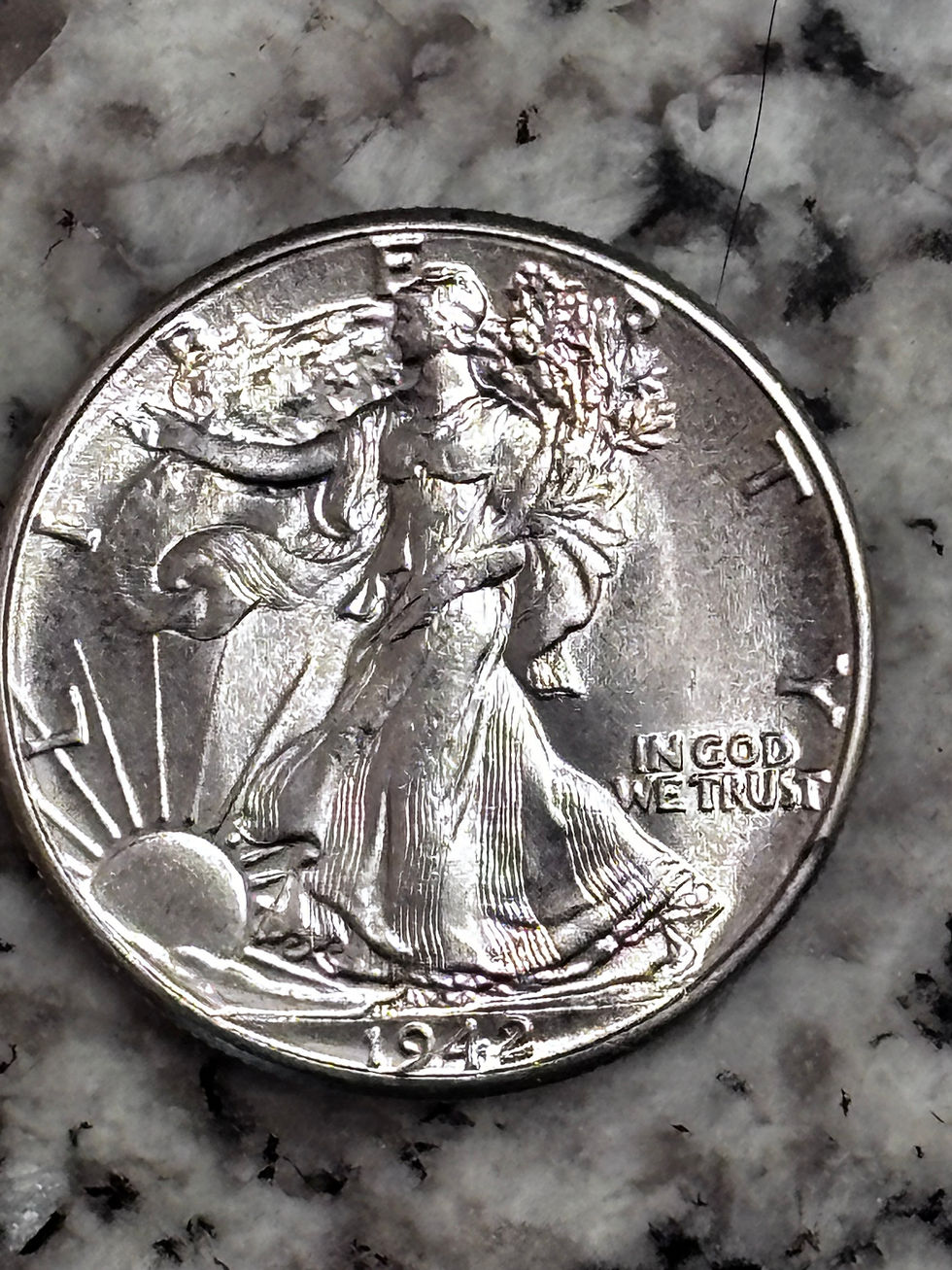
Introduced in 1916, the Walking Liberty Half Dollar quickly became one of the most admired coins in United States history. Weinman’s obverse depicts Liberty striding toward the dawn, draped in the American flag, with her right hand extended and branches of laurel and oak in her left arm. The reverse features a powerful eagle perched on a mountain crag beside a young pine sapling. Collectors have long admired the coin not only for its symbolism of freedom, renewal, and strength, but also for the technical difficulty of bringing its sculptural design up fully in the striking process.
Specifications
Walking Liberty Half Dollars were struck in 90% silver and 10% copper. Each coin weighs 12.50 grams and has a diameter of 30.6 millimeters, with a reeded edge. This silver composition and large format give the coin a substantial physical presence, while the design itself makes it one of the most visually compelling issues in all of American numismatics.
The 1941–1947 Short Set
The 1941–1947 short set consists of 20 business-strike coins and gives collectors a focused way to enjoy the later years of the series. Philadelphia, Denver, and San Francisco each produced Walking Liberty Half Dollars from 1941 through 1946, while only Philadelphia and Denver struck the denomination in 1947. There is no 1947-S issue, a detail that neatly closes the set and gives it a clearly defined finish. For collectors seeking a late-date Walker set with strong visual appeal and manageable scope, few projects are more satisfying. The table below pairs each issue’s mintage with Anthony Swiatek’s practical marketplace observations, making it easier to compare dates at a glance.
| Year/Mint | Mintage | Anthony Swiatek’s Description |
|-----------|---------|-------------------------------|
| 1941-P | 24,192,000 | “Not difficult to locate in all mint states, even with strong or full strike.” |
| 1941-D | 11,248,000 | “Easily located in all mint states, even with strong strikes. Fully struck coins are available.” |
| 1941-S | 8,098,000 | “Easily located in all mint states. However, this issue is one of the most difficult out of all the ‘S’ mints to locate with a strong or full strike. As most Walking Liberty lovers know, it is the hand which is usually struck flat. The full head can be located on a coin, but the difficulty is trying to locate one with a hand to match.” |
| 1942-P | 47,818,000 | “Not difficult to locate in all mint states, even with a strong or full strike.” |
| 1942-D | 10,973,000 | “Not difficult to locate in all mint states, even with strong and full strike.” |
| 1942-S | 12,708,000 | “Not that difficult to locate in all mint states, but not with a strong or full strike. As with the 1928-S production this date also comes struck with a smaller and larger size ‘S’ mintmark. No big deal for either date. In other words, don’t get duped into paying more because some con artist or unknowledgeable dealer tells you one is rarer than the other.” |
| 1943-P | 53,190,000 | “Mintage wise this date is king. Easy to locate in all mint states, even fully struck.” |
| 1943-D | 11,346,000 | “This coin is king of the Denver issue for mintage production. Not difficult to locate in all mint states, even with strong and full strike characteristics.” |
| 1943-S | 13,450,000 | “Not to be outdone, San Francisco presented its largest half dollar production figure for the series. Coins which do not possess a full strike are easily located. Strong and fully struck specimens are the desired ones and not easily located. See description of 1941-S issue.” |
| 1944-P | 28,206,000 | “Not difficult to locate in all mint states, even with a strong or full strike.” |
| 1944-D | 9,769,000 | “Not difficult to locate in all mint states, even with a strong or full strike.” |
| 1944-S | 8,904,000 | “Available in all mint states. Problem arises in the realm of the fully struck. When completing the short set (1941–1947), this is the date which is usually the last to be located with a strong or full strike. It is the most difficult of the late-date ‘S’ mints (1941-S to 1946-S) to obtain. See comments for 1941-S issue.” |
| 1945-P | 31,502,000 | “Not difficult to locate in all mint states, even with strong or full strike. Can lack that eye-appealing, blazing, lustrous surfaces.” |
| 1945-D | 9,966,000 | “Not difficult to locate in all mint states, even with a strong or full strike.” |
| 1945-S | 10,156,000 | “Coins not possessing a full strike are easily located. Strong and fully struck specimens are the desired ones and not easily located. See comments for the 1941-S issue.” |
| 1946-P | 12,118,000 | “In all mint states, this issue is not difficult to locate even with a strong or full strike.” |
| 1946-D | 2,151,000 | “Yes, low mintage issue. Hoarded at time of release … strike does not present a problem for this issue.” |
| 1946-S | 3,724,000 | “Well and fully struck specimens are the desired ones. They are not at all easily located. A true full-strike gem is a sleeper. ‘S’ mints should look like full-strike 1946-P’s, with the addition of that little letter. However, suggest you not pass up the strong-strike gem specimen.” |
| 1947-P | 4,094,000 | “The best investment of all issues struck at Philadelphia since 1941. Can be located in all mint states, with a strong and full strike. However, just be aware that the best strikes of the 1947 Philly and Denver issues will show slightly less sharpness than earlier issues.” |
| 1947-D | 3,900,600 | “Can be purchased in all mint states. Strong and fully struck specimens are not too difficult to locate.” |
| 1947-S | No production | “No production for year of 1947, which marked a striking halt of one of our nation’s greatest artistic creations; a numismatic masterpiece, the Walking Liberty half dollar.” |
One of the real advantages of studying this short set through Anthony Swiatek’s lens is that his observations move beyond simple mintage totals. They help collectors understand how these coins are actually encountered in the marketplace—where strong strikes are readily available, where full strikes become elusive, and which dates deserve extra patience when searching for superior quality. For anyone assembling a more carefully selected set, those distinctions matter.
What to Look for in the 1941–1947 Issues
When evaluating Walking Liberty Half Dollars, four qualities deserve special attention: eye appeal, luster, originality, and strike. Eye appeal is the immediate visual impression a coin makes, including brightness, toning, balance, and overall attractiveness. Original mint luster should still display a lively effect when the coin is tilted under light. Original surfaces are equally important, as they suggest the coin has not been harshly cleaned or otherwise altered. Strike quality, however, is where many collectors separate average examples from exceptional ones.
On the obverse, weakness often appears at Liberty’s head, left hand, and the central folds of the skirt. On the reverse, softness is commonly seen on the eagle’s breast, leading leg, and the pine sapling. Coins that show strong detail in these areas tend to stand out immediately. That is why date-by-date knowledge matters so much in this series. Many Philadelphia and Denver issues in the short set can be found with pleasing strikes, but several San Francisco coins require a much more careful search.
The 1941-S, 1943-S, 1944-S, 1945-S, and 1946-S are especially important dates for collectors who value strike quality, with the 1944-S often singled out as one of the more challenging late-date San Francisco issues to locate with a truly strong strike. By contrast, Philadelphia coins from the early 1940s are generally easier to find in well-struck Mint State. The practical takeaway is straightforward: whenever possible, buy the coin with the best strike and most original surfaces you can comfortably afford.
Conclusion
The 1941–1947 Walking Liberty Half Dollar short set remains one of the most rewarding ways to explore classic United States coinage. It offers celebrated design, historical depth, manageable scope, and just enough nuance in strike and availability to keep the pursuit engaging. By combining exact date data with the insight of respected specialists such as Anthony Swiatek, collectors can approach the series with greater confidence and a clearer sense of what makes these late-date Walkers so enduringly appealing.
Whether you are building your first set, upgrading key dates, or refining a more advanced group, this short set continues to deliver both enjoyment and lasting collecting value—qualities that lie at the heart of the hobby itself.

Comments